Showing posts with label POSTURE. Show all posts

Tuesday, 5 November 2019

NO !! Your leg pain is not just SLIP DISC...

Image result for sciatica


It won't be wrong if I quote that BACK PAIN is second most common condition after common cold which makes people suffer affecting their daily life. Every third person has faced atleast one episode of back pain in their life. Our SPINE encloses and protects spinal cord which carry information from brain to the body via nerves. Without such information the body cannot control, move or feel anything effectively making you senseless and motionless.


"Are you suffering from back pain? 

Or

Do you get a pain travelling down your one or both legs? 

Or

Is it difficult to walk few minutes or few steps without a back or leg pain? 

Or 

Do you know someone who is facing such a complaint?"


Read the article carefully to understand what is going wrong inside your body. Read it as you will get to know things beyond your doctor might have missed to share with you.


You may have a leg pain travelling down along with back pain or sometimes without any back pain. The reason for leg pain can be nerves compressed from the spine or even at your hip. Sometimes muscular pain mimics like a nerve pain in the leg which makes you and your doctor confused. The difference between leg pain due to nerve or muscles is that former causes sharp shooting or electric current like leg radiation whereas the latter creates a continuous dull achiness in the affected leg along with pain in the muscle involved.

Image result for bulging disc'


If you have seen a human spine, it looks like a curvy snake formed by multiple bones called vertebrae arranged in a manner to give it "S SHAPE " when looked from side view. But from front or back view it looks like a straight vertical spine. Any deviation in these curves can put the spine structures under stress causing lot of muscle imbalances or vice a versa.


Image result for misaligned vertebrae'


When your muscles doesn't support the spine symmetrically it can cause excessive stress between couple of vertebrae causing reduced space for the nerves exiting from the spine. Hence, leading to compressed nerves causing painful radiation in the leg. These imbalances can even create severe muscular spasm putting heavy pressure on your affected nerve and the result is your painful suffering again.


Interestingly, the above mentioned reasons can put the disc under pressure and making it appear like a bulge or on MRI Scan. This should be called as false or pseudo disc prolapse causing nerve irritation and leg pain. This type of bulging can disappear or improve once the pressure between vertebrae goes away.

   Image result for gluteus medius referred pain

I have come across patients who comes with a dull pain in the hip which also radiates down the leg but does not behave like sharp shooting pain. And the reason is not your spinal disc or nerve but a muscle around the hip known as GLUTES MEDIUS (the HIP Abductor) which may have a TRIGGER POINT - muscle knot causing nerve like pain which people often confuse with sciatica due to nerve compression. 


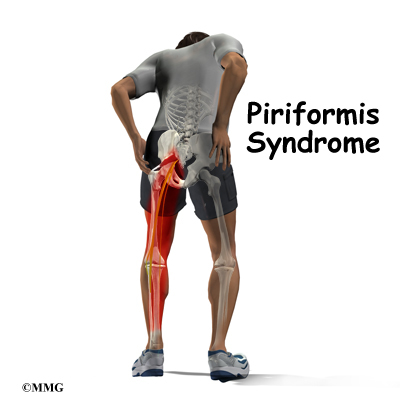
Image result for piriformis syndrome

 A deep muscle of the hip known as PIRIFORMIS (the HIP Rotator) is placed right on top of your sciatic nerve and in some cases this nerve pierces from within the piriformis muscle. If this muscle becomes tight it can cause a similar nerve pain but thankfully then the reason is not your spine. This is more common in people who keep purse in their back pocket and also when people sit with scissored legs (Cross Leg Sitting).


Related image

A disc is a doughnut like structure with hard outer shell filled with jelly like material inside. Disc is found between the vertebrae of the spine adding shock absorbing effect. In case there is a sudden trauma or repetitive wrong movement pattern in daily life, the disc wall gets weakened and starts bulging mostly backwards and outwards. If the nerve gets compressed by this bulging disc as it is lying very close to it, you can get a sharp shooting pain radiating down the leg. This condition is popularly known as SLIP DISC OR SCIATICA. The people describe this feeling as painful electric spark travelling down the leg. Your bulging disc or slip disc cannot cause leg pain if it is not pressing on to a nerve.


Bulging discs are very common and not everyone who has a bulging disc go through pain. Infact, after 30 yrs of age, every 10 years increases the chance of finding one or more bulging discs with or without leg pain. So when disc bulge is so common then what is causing your leg pain. Careful examination can reveal whether your nerves are compressed due to muscular imbalance, a mis-alignment in the spine or a disc compression on your nerve.


This information is totally in contrast with MRI reports showing disc prolapse as the possible cause of your pain. Trusting the MRI reports without careful examination can misguide you towards unnecessary treatments not required for your stage of the disease.  If you are better informed then you can reduce your suffering by heading towards the effective treatment for your condition.


The information on this blog is helpful in creating awareness related to different problems which produces similar symptoms and often confuse against reaching better treatment approach. 

Please do not consider this blog as a medical advice and do visit your doctor or physiotherapist whenever you experience such symptoms.


Feel free to explore more information by commenting here anytime.


Regards,

Dr. Kunal Vashist,PT

MPT(Ortho), Manual Therapy

DryNeedling Practitioner

Email ID - kvashist.physio@gmail.com

Contact No. 9968302757

More Than Physio... Clinics                       


Saturday, 29 June 2019

Know About Your MYSTERIOUS Neck Pain

Related image

Muscular aches and pains are becoming common day by day. Almost all of us face some issues with our muscles and joints as we cross our student life and enter professional life especially if work involves lot of screen time and sitting. 


During school days, kids are forced to sit long hours for studying in the classes as well as at home or tuition but they can still get away from pain as the body can take and forget muscular stress easily. Muscular health is also better at that time because your body is mobile, agile and undergo short periods of high activities like running, indoor or outdoor games etc. As a child your carefree attitude does help in keeping physical and mental stress under control. In addition the body weight is well under control which helps you moving faster. 


With time you enter professional life and then you are bound to do a sitting job in front of laptop or computer for long hours. Gradually work and family do add up some stress to life as you want to perform better in both. That carefree attitude is gone by the time you enter professional and personal maturity. When you move less, you hamper your mobility and your strength declines due to long hours of physical inactivity. Decrease in muscular strength and mobility is just the adaptation of your body towards reduced physical activities. 


Long hours of inactivity, stress and poor diet altogether increases your body weight disallowing you to remain agile the way you were during your early childhood. The collective response from your body is aches and pains gradually becoming unresolved and chronic. 


Neck pain is usually very common in these conditions and can interrupt with your healthy living. It doesn't seem like an emergency but it doesn't allow you work peacefully also. By the time you realize neck pain is a problem it is too late as your body gets well adapted to your current way of living. It is so natural for all of us to find an instant cure but I wish we had such an approach to deal with it. A prolonged neck pain is a consequence of multiple changes mentioned in initial paragraphs of the article which your body has acquired in so many years. A permanent solution is reversal of at least some of those changes which definitely doesn't happen instantly. 


You do not have neck pain because a particular spinal vertebrae or spinal joint has reduced space or degenerated or damaged. You have pain because you do not move functionally well as a whole. Medicines have a very limited role in treatment of neck pain. In fact anything which does not improve how you move or sit through out the day, might not help in long term when it comes to joint and muscles health.


The current evidence based information about neck pain management is as follows:


  • X-Rays are not so informative in describing the source of neck pain.
  • MRI is an investigation of choice but should be used very carefully as it can pick up issues which are irrelevant for your pain. Also the reporting can act as a nocebo, creating new area of pain which you never had or can delay your recovery as you might get relatable anxiety and fear-avoidance behavior leading to reduced activities.
  • Electrotherapy like TENS, IFT or Diathermy doesn't have supporting evidence in treatment of prolonged neck pain.
  • Therapeutic Ultrasound can provide deep tissue heat and micro-massaging effect in case of acute pain for some days but does not qualify as a treatment for neck pain.
  • Wide use of mechanical traction device for neck pain has been stopped by many western countries because of associated consequences and negligible results.
  • Manual (Hands-On) techniques like mobilization, manipulation and massages via osteopathy or chiropractic techniques have some effect in initiating recovery but only gives you short term relief.
  • Postural Correction is also over-rated as you tend to force your weaker muscles in order to sit upright. And that conscious effort will last only for couple of minutes the moment you get busy with other things around you.
  • Stretching is helpful in temporarily DE-Stressing the muscular tension and helps in regaining the range of movement.
  • Strengthening the weaker muscles can help in sustaining the correct posture for long time as it reduces the stress on postural muscles. Strength training in full range of movement can help with improving your neck motion as well.
Feel free to connect with me and discuss a lot more in detail about various types of neck pain and their solutions.

Dr. Kunal Vashist,PT
MPT (Ortho), Manual Therapy
Dry Needling Practitioner

kvashist.physio@gmail.com / 9968302757

Find me on FACEBOOK Page : More Than Physio


Tuesday, 22 May 2018

POSTURE - Position of the body in which you do Nothing to Everything

Image result for posture


The position acquired by the body to do daily activities like walking, running, sitting, or even sleeping etc. is called POSTURE. 


The posture is perfect when you work with maximum efficiency but minimal stress on the body. Similarly with bad posture the same work becomes stressful and can have a bad impact on your health.


Muscular pains and stiffness are common complaints associated with bad posture. At times poor posture can give you serious health conditions like spondylosis and nerve compression. It can also increase joint stress in back, neck, hip or knee leading to faster degeneration which might then become arthritic and painful. Almost always the shoulder and neck pain is linked to your body posture. 


At early age, body can still fight with bad postural habits and you can get away with least or no symptoms. Although, now a days the modern inactive lifestyle is taking toll on children at early ages. it is important to note here that my youngest patient for neck or back pain is now around 10 yrs of age. The good part is that even with worse painful condition they heal quickly and get back to normal.


Solution: 

  • Reduce screen time. (Television / Mobile / Laptops)
  • Promote Physical Activities (Prefer Outdoor games not Media Games)
  • Exercise Daily 
  • Correct Ergonomic Education (Sitting Surface & Posture / School Bags)


But when you reach your 30's it is difficult to restore the good postural habits because you have lost the memory of being in good posture for so long. Your joints and muscles cry for some mobility and strength. Now how do you get that when you are so habitual of sitting on that sofa or chair for many hours. Please don't tell me that you are fairly active. When you getup in the morning, from toilet seat to car seat and then from office seat to Sofa seat in the evening, YOU sit all day. 


As you age, you recover very slowly and it takes more effort to see very subtle changes. So the first step is to prevent the loss of joint mobility and muscular strength. Even if you have lost it you can still see positive changes at any age for e.g. muscles do become stronger even if you strength train them at 90 years of age (proven in studies).


Solution:
  • Correct Ergonomic Education (Sitting posture / Friendly Furniture)
  • Reduce Sitting Hours
  • Strength Trainin Daily at home or GYM Weight Training Every other day)
  • Physical Activities (Walking / Running / Swimming / Any Sport)
  • Active Social Life- Beat your stress (Posture is also linked to Emotional well being)


Our whole life is divided into Days and Nights or Activities and Rest. You need to sleep well in order to recover all the energy you lost during work or exercise. Good sleep and recovery comes from good sleeping posture. Our spine is designed to be 'S' shaped and all curves in the spine should be well supported in order to keep your muscles relaxed during sleep. 


Solution:
  • A good Semi-Firm Mattress. (Say no to Spring / Rubber Mattress)
  • Pillow support under or between knees. (Depends on face upwards or side lying).
  • Pillow Support under your neck (Not just the head).
  • Dark Room.
  • Avoid sleeping on your tummy.


If you keep yourself moderately active, reduce your long sitting/standing hours and work on your better sleep, then you are pretty sorted with issues linked to bad posture. Remember your body will be thankful to you if you listen to it and make it stronger.


Feel free to comment below in case you need some more information on how to move correctly and efficiently.